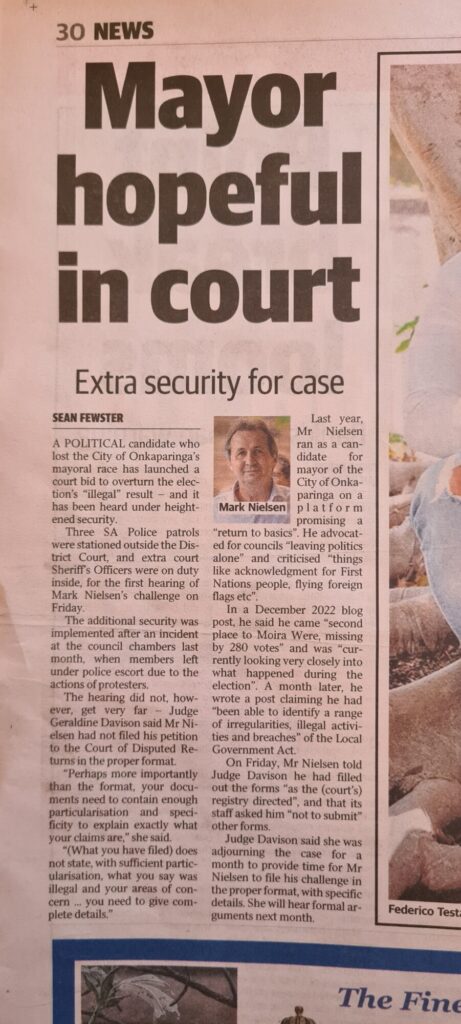
The Court of Disputed Returns dismissed my case against the Electoral Commission of SA (ECSA) and the City of Onkaparinga on 14 July, 2023. My supporters and I witnessed 32 breaches of the Local Government (Elections) Act 1999 and were victims of what we considered to be a serious case of Defamation by the Onkaparinga City Council during the 2022 Council Elections.
I asked the Attorney General of Norfolk Island if he could provide some commentary to my case from his informed perspective. I have inserted his comments in the relevant sections.
Background
I ran as a candidate for Mayor in the November 2022 City of Onkaparinga Council Elections. I campaigned alongside another 11 candidates. Together we nominated for the 12 Councillor positions during the 2022 council election. We campaigned together and worked as a team, determined to make a difference in Onkaparinga by giving the residents and rate payers a voice and a team of Councillors dedicated to working for the betterment of the local community.
The counting of votes began on 12 November 2022 with Moira Were receiving 280 more votes than me. Only 1 of my 11 running mates, Kevin Rilett was elected and so became Councillor of Pimpala Ward.
The “Onkaparinga Clubs Forum” was established with its controlling and management team made up of one Harvey Jolly, named as the “Chairman” and two elected members from Council and up to four Council staff representatives, in order to allow “clubs to align with and support the Community Plan and the Sport and Active Recreation Plan.”
I alleged that on Monday, 17 October 2022 9:56 AM the “Onkaparinga Clubs Forum” sent an email to a large number of sporting clubs within the City of Onkaparinga Council area and PUBLISHED defamatory and unlawful information about me and various candidates who were to run for election in the then upcoming Council Elections.
I alleged that all those persons who were identified as “VERY HIGH RISK” in the published materials, and shaded in a red colour and whose names were placed at the bottom of the lists, including my name, were defamed by such publication and none of those persons so identified in that publication were successfully elected in the ensuing Council Elections, a copy of the publication can be downloaded by clicking here, AND
I alleged that none of those candidates who were identified in the “VERY HIGH RISK” category were successfully elected in the said Council elections, as a direct result of the publication by the “Onkaparinga Clubs Forum” (an entity created by the City of Onkaparinga Council for the purposes of unlawfully seeking out candidates they wanted elected).
It should be worth noting that the only candidate in my team who was elected was Kevin Rilett who was not identified as “VERY HIGH RISK” and he was involved with the Morphett Vale Tennis club and his wife was President of that club. Since the “Onkaparinga Clubs Forum” wanted candidates who would support clubs he was an obvious choice as someone to favour.
Our team and supporters determined there were major irregularities during the election count so I requested a recount. The Electoral Commission determined there was little likelihood of a recount changing the election result, so a recount was rejected on 18 November. Moira Were was announced the elected Mayor. On the 22 November the election result was formally certified and published by the Returning Officer.
I immediately began preparations to take my case to the Court of Disputed Returns.

How the case proceeded
It took over 7 months of hearings which focused almost exclusively on technical arguments by the Electoral Commission. On 14 July 2023 Judge Davison ruled that my case be struck out.
This court does not permit an appeal.
The Attorney General of Norfolk Island, hereinafter referred to as the AGNI, has reviewed my case and noted that the Local Government (Elections) Act 1999 which applies to my case states in;
Section 71(4)
The Court must act according to good conscience and the substantial merits of the case without regard to legal technicalities.
He went on to say that the reason for this, is that in this particularly niche area of the courts, it is common for self-represented persons (like myself) to file claims, therefore the court is required to act in the public interest, giving weight to the merits of the case and its evidence, rather than focusing on the technicalities of such cases.
My case began on 13 December 2022 when I lodged a Form 2 as an ‘Originating Application’ and an Affidavit as directed by the Court Registry but at my first Directions Hearing on 17 February 2023 the Court said these were the wrong forms.
The Court ordered that by the next Directions Hearing of 31 March 2023;
“The Applicant to file Application in the form of a petition.”
I complied with this order by filing a Petition Form called the ‘Originating Petition’.
This new document set out my claim in detail. The Electoral Commission made submissions to have my case dismissed because the Originating Application (the first document) did not have sufficient particularisation of allegations in accordance with Local Government (Election) Act and the Rules of Court.
That is a long way about saying it did not have enough information.
At this Directions Hearing of 31 March, 2023, Judge Davison addressed Mr Pager, legal counsel for the Electoral Commission of SA, according to the court transcript;
“And on the materials that I have before me, as I say, I’m not prepared to summarily dismiss this application today.”
The AGNI made the following comments;
“On the face of the judgement, Judge Davison not only refused to dismiss Mr. Nielsen’s case at that time, she furthermore insisted that the Electoral Commission formally reply to the new document as further stated in the court transcript:
“… and I also would like a reply to be filed by the commissioner in respect of the materials that are now before the court in the form of what’s called the originating petition to address, in particular, what I’ll call the substantive claim in there. As you know, there are a number of claims, in respect, breaches of various sections of the Act; you’ll no doubt deal with them in your reply as well but I’m, in particular, interested in the substantive claim.”
Judge Davison furthermore said to Mr Pager:
“Having done that, I will then be considering making orders for discovery in two weeks.”
It would appear from the decision and taking into account the transcript, in the second hearing of 31 March 2023, Judge Davison was making clear indications that Mr Nielsen had a “substantive claim” and there was a case to be answered. At that stage in proceedings, Judge Davison states that she would consider making orders for discovery, further indication that she had some sympathy for Mr Nielsen’s case. It would appear that this was the last time Judge Davison offered Mr Nielsen any relief.
In the ‘Reasons for Decision of her Honour Judge Davison’ received by the Applicant on 24 October 2023 there was no mention of the content of the ‘Originating Petition’ lodged for the hearing of 31 March 2023 whereas in the transcript of that hearing she made reference to it as;
“… what I’ll call the substantive claim …” page 8 line 36,37
In contrast Judge Davison in ‘Reasons for Decision of her Honour Judge Davison’ only referred in detail to that very first document that was so deficient and stated;”
21. “In short, there is no material before me at all from the initial petition that would enable me to declare this election void.”
There are two questions at this point;
- Why did I submit the first Petition that was so deficient?
- Why did the Judge change her mind so drastically?
The Petition.
The Local Government (Elections) Act 1999 allows 28 days after the end of an election in which to issue proceedings. There was however an uncertainty about the actual date for the end of the election.
Moira Were had been provisionally elected Mayor on 13 November 2022, then after my request for a recount which was rejected on 18 November she was announced to be Mayor on the same day but the Electoral Commissioner,
Mick Sherry, did not formally certify the election until 22 November.
So there were 3 dates to consider so considered it best to use the earliest date of 13 November that meant I should file my case in court by 5pm on Friday 9 December 2022.
I attempted to file a detailed Statement of Claim to the Court Registry on Wednesday 7 December 2022 but they refused to accept it. I was instead given another 24 hours to prepare my documents as a Form 2 with an accompanying Affidavit. I resubmitted my application on time, in a reduced format due to the significant time constraints. My main aim was to file my claim in whatever form time allowed then to add the detail later.
When I filed my documents on 8 December there was a delay from the court registry as this particular type of claim had not been filed in the Court of Disputed Returns in such a long time, the staff could not find the correct stamp to seal the document and there was still confusion over which forms to use. The court registry took until 13 December 2022 to formally seal my document which made my filing ‘out of time’. This became the focus of the Electoral Commission in seeking to have my case dismissed. I say these delays were out of my control and I submitted my documents to the court within the required time frame.
In my Affidavit of 8th May 2023 to the Court I stated;
(8) At Trial witnesses will be called to give evidence of “contemporaneous notes” kept about the delays in sealing the documents from the Registry’s position. The Registry said they did not know which Forms to use and that they could not find the stamps in order to seal the documents. They admitted they were not sure how to approach the filing (as to their knowledge) this kind of Application has never been before the court in South Australia.
It was at the very first hearing in this case on 17 February 2023 that I had to answer these questions from Judge Davison on the late filing of Forms and why enough detail had not been provided.
The AGNI commented;
“It can be noted in the transcript that Judge Davison stated that the wrong Forms had been used. Mr Nielsen explains that he was specifically instructed to use these forms by the Court Registry, who refused to accept his initial detailed ‘Statement of Claim’ document.
The Court instructed that a ‘Petition’ form had to be used. Mr Nielsen responded to the Court that the Uniform Civil Rules 2020, did not have a Petition form and that it only existed in the now defunct version of the Uniform Civil Rules. Mr Nielsen asked Judge Davison, something to the effect of; Why were the lawyers for the Electoral Commission and Council using the old Forms?
Judge Davison responded that it didn’t matter what forms you use it’s the content that matters.
Mr Nielsen claims he discussed with the court registry using the new Forms, by adding in the word ‘PETITION’ at the top.
“In the end, we used the old Forms. The reason for all this confusion is the Act requires the Applicant to file a ‘PETITION’. The legislation is out of date (not in agreement) with current Court Rules and I assert that I have been prejudiced by these circumstances that arose that led to me filing late and without all the details of my case that I had prepared.”
During the hearing of 12 May 2023 the Judge ordered that the Uniform Civil Rules 2020 should apply. These rules had been in place for the previous 2 years so why was this order necessary?
If the current rules had been applied to Mr Nielsen’s case, there would not have been a claim of ‘incorrect filing of documents’ or as Judge Davison said in ‘Reasons for Decision of her Honour Judge Davison’;
“On 17 February 2023, I raised with the applicant that his application was not in the appropriate form for a petition pursuant to the LGE Act.”
Why was the focus of Mr Nielsen’s claim turned to the form and not the content of the form? I also refer back to the Judge Davison’s statement on 17 February 2023 that;
‘It doesn’t matter what Forms you use it’s the content that matters.’
Following the filing of the “substantive claim” it is then interesting to note in ‘Reasons for Decision of her Honour Judge Davison’;
27. Ultimately, I determined that there was no reasonable basis upon which any claims that had been made could have affected the outcome (of) this election.
Mr Nielsen was not given an opportunity to present and argue the evidence in his case. The case did not progress past the technicalities of Court Rules and legislative procedure.
As I stated earlier, according to the Local Government (Election) Act 1999;
Section 71(4)
The Court must act according to good conscience and the substantial merits of the case without regard to legal technicalities.
Ultimately, it appears the dismissal of Mr Nielsen’s case rested on the fact that any attempt to amend the initial application was not permitted. His case therefore had to rest entirely upon the inadequate ‘Originating Application’ that he was required to rush to file on 8 December 2022 after his first attempt to file a detailed Statement of Claim was rejected by the Court Registry.
It was argued by counsel for the Electoral Commission that any new evidence or particulars could not be added to the ‘Originating Application’ because they were effectively outside of the 28 day time limit.
Nevertheless the Act states quite clearly;
71—Powers of the Court
(1) The Court must sit as an open court, and its powers include the following:
(i) to amend or allow the amendment of a petition or reply;
Mr Nielsen believes it was in the public interest for the substantive evident of non compliance with legislation, major irregularities and even potentially criminal interference in the election outcome that my case should have been allowed to proceed in Court and be judged on its merits.
He had filed with the Court two affidavits from candidates for the election, who were not in his team, who reported having submitted formal complaints to the Electoral Commission concerning the same defamatory document published by the Onkaparinga Clubs Forum that had targeted me. He also had reasonable evidence to suggest a third candidate had also submitted a complaint. As a result of those complaints the Onkaparinga Clubs Forum was ordered by the Electoral Commission to remove that document.”
Conclusion
Since legislation does not allow an appeal there was no further avenue for my case to continue except for a Judicial Review but these reviews are not concerned with whether the “right” outcome occurred but whether the decision maker was lawfully permitted to reach the outcome which occurred. The outcome of a Judicial Review would be uncertain at best and expensive to say the least.
This case summary has only addressed details of the court case and legal machinations but at some future date I will tell the story of the evidence that was never heard which supports my allegations of at least 32 separate breaches of the Local Government (Elections) Act 1999.
The Court considered how my case conformed to Court Rules and what I would call the technical requirements of legislation but did not examine any of the evidence except in a perfunctory manner. Consideration of the evidence would have happened at a trial but that was ultimately denied to me.
What is most concerning to me is the Electoral Commission’s complete neglect with regard to addressing the significant flaws in the system, highlighted by my team of 57 volunteers. They would rather avoid responsibility by the use of legal manoeuvres. They are the custodians of this Act, yet it struck us that we were potentially the first group who have witnessed a local government election counting process with such diligence.
A quote from the Affidavit of one scrutineer;
“Mr Williams (ECSA Deputy Returning Officer) told the group that this was the largest group of scrutineers that had ever attended a council election and they had not made preparations to accommodate our numbers. I noted there had been insufficient planning on the part of ECSA to accommodate our team and the timetable of events that we had been provided with was superficial and had not been considered in practical terms should a group of our size arrive to scrutineer the election counting.”
They were perhaps accustomed to being a little ‘loose’ with following the procedures outlined within the Act – until now. What does this mean for ALL council elections around Australia? Is this happening everywhere; we just don’t know because we are not there to bear witness.
The Electoral Commission is not working for the public interest.
Based on my experience during this election I no longer have any confidence in the Electoral Commission of SA and it leads me to question its handling of all past and future elections.
A full Royal Commission, unfettered by limited terms of reference is warranted and necessary to protect the democracy of our state and country.